Evolution of Coin Design in India
(1500-1599) C.E
(4 items)
Evolution of Coin Design in India(1500-1599) C.E
(4 items)
(4 items)
Vijayanagara empire coins
by Tuluva Dynasty
by Tuluva Dynasty
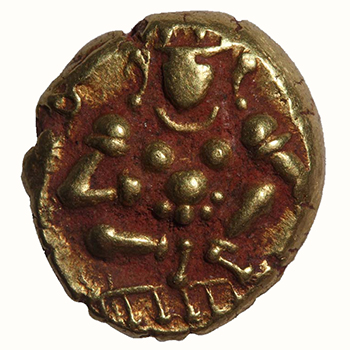
The Vijayanagara empire came into existence around 1336 AD, founded by Hakka and Bukka, who were (according to some sources) two revenue officials serving under Kakatiya rulers. The empire spanned three centuries and produced four dynasties: Sangama, Saluva, Tuluva, and Aravidu. Krishnadevaraya, considered to be one of the greatest of the Vijayanagara kings, belonged to the Tuluva dynasty. He restored peace, rearranged the administration, and commanded the allegiance of previously independent kingdoms. When he visited the Tirupati temple to perform the kanakabhishekam (a sacred ritual where an idol is showered with gold), he minted special gold coins just for the occasion. On the front of this coin, you can see Lord Balakrishna seated in the regal Lalitasana pose. The reverse features the name of the king in Nagari—it reads, Shri Pratapa Krishnaraya. Obverse The king is seated with folded legs.
Details >>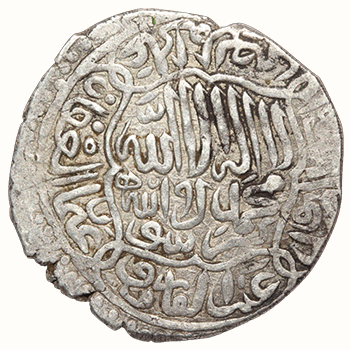
Shahrukhi Coin
by Mughal Dynasty
by Mughal Dynasty
Babur, the founder of the Mughal dynasty, was a descendant of Timur and Genghis Khan. One of the ways in which he pledged his allegiance was by introducing the Shahrukhi denomination of coin to the Subcontinent. Shahrukhis were flat, round silver coins first issued by the Timurid ruler Shah Rukh in the 15th century. These coins had a good run in India under Humayun and Akbar until they were replaced by the rupee. Babur was born a prince in Ferghana, present-day Uzbekistan, with ambitions to rule Samarkand. When he failed to hold onto his throne there, he came eastward and, after the Battle of Panipat in 1526, invaded Agra and Delhi. This silver coin weighs nearly 5 grammes, and on the obverse it features the Kalima (the Islamic invocation to Allah) and the names of the four caliphs. On the reverse, it has the date the coin was minted (Hijri year 910, 1504–1505 AD), the mint town (Badakhshan), and the name of the emperor. Generally speaking, Shahrukhis issued by Babur would carry the lengthy legend of: Al-Sultan Al-Azam Wa Al-Khakan Al-Mukarram Zahiruddin Muhammad Babur Badshah Ghazi. The obverse has a cartouche inside that is inscribed Kalima Reverse. The reverse mentions the date, mint town, and name of the emperor.
Details >>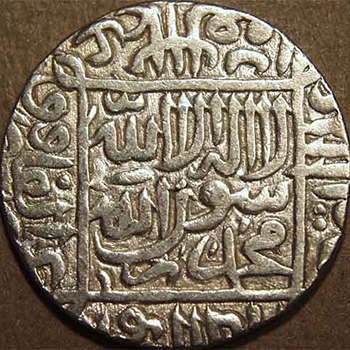
Sher Shah Suri
by Sur dynasty
by Sur dynasty
Sher Shah was one of the greatest Muslim rulers in India. He served in the Lodi military, ending up in Bihar and eventually gaining a position of power there. When the Mughals defeated the Lodis, the sultanate started to fragment, and Sher Shah took the opportunity to consolidate his power and even extend it east into Bengal and west into what is now Uttar Pradesh. In his short reign of 7 years (1538-45), Sher Shah transformed northern India. He built four major roads criss-crossing his empire and provided them with fruit trees all along, with rest stops and wells at periodic intervals. He also minted a substantial amount of coin, introducing the 11 gm silver rupee to replace the 10 gm billon tanka and also providing copious copper coinage based on the paisa. The provision of roads and coins combined to facilitate trade, and the economy must have boomed. The monetary reforms persisted after the Suri reign ended; even today, India's currencies are the rupee and paisa. The system of tri-metalism that came to characterise Mughal coinage was introduced by Sher Shah Suri. While the term rupya had previously been used as a generic term for any silver coin, during his rule the term rupee came to be used as the name for a silver coin of a standard weight of 178 grains, which was the precursor of the modern rupee. Shar Shah died in an unfortunate accident when a rocket his own forces had fired rebounded onto a pile of ammunition near where he was situated. He was mortally wounded in the blast.
Details >>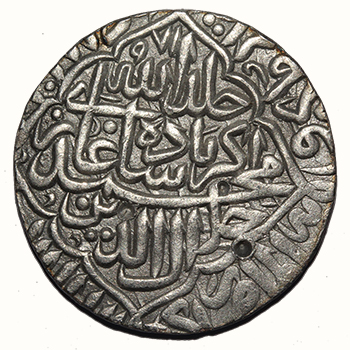
Coins of Akbar
by Mughal Dynasty
by Mughal Dynasty
This silver coin was issued by Akbar, minted at Agra, and is known as the ‘Kalima type’. Inscribed on both sides, the coins consist of the ‘Kalima’ (Islamic affirmation of faith) on the obverse and the name and title of the issuer, date, and mint on the reverse. On the obverse side of the Kalima type of coin is inscribed the Islamic affirmation of the faith, "La Ilaha Illallahu Muhammadur Rasulullah", along with the names of the four caliphs: Abu Bakr, Umar, Usman, and Ali. In the later part of Akbar’s reign, his coinage changed considerably. The Kalima was dropped from the obverse and replaced by "Allahu Akbar Jalla Jalalhu" (God is great; bright is his glory). And the reverse saw the deletion of the king’s name and title. The Ilahi year and the Persian date remained.
Details >>