Product Design
Batch 1970-1972
(6 items)
Product DesignBatch 1970-1972
(6 items)
(6 items)
Food Carriage System
by Jai K. Bansal
Details >>
by Jai K. Bansal
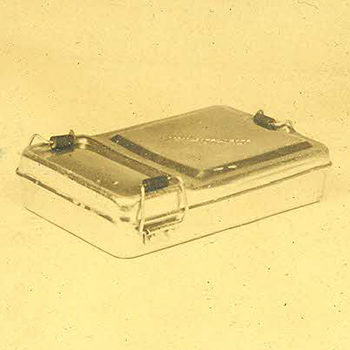
Any container that is used for carrying food can be called a food carrier. There can be various types of food boxes depending on their size, compartmentalization, and mode of carrying. Under this project, the food box, which is used for carrying food for industrial and office workers, has been redesigned. A third party transports these boxes from the kitchen to the office or industry site. Since the industrial revolution, the problem of food transportation has become more serious in society. In Bombay city itself, it is more than 30 years old. More than 2 lakh luch boxes are transported daily in Bombay alone. Lunch should be available to men at their place of work during lunch hours. As many industrial sites are away from the main city, good hotels or canteens are not situated near the place of work. This necessitates that the worker arrange for his own food, thus giving rise to the evolution of the food carrier. It is difficult to prepare the food very early in the morning, and it is also inconvenient for the worker to carry the food box early in the morning. This brings about the existence of a third force that transports these boxes from the kitchen to the site.
There are numerous food box manufacturers on the market. However, the one shown in the photograph is the most commonly used. It has an outside container of G.I. sheeting, and inside it contains four compartments of aluminium. This is taken for analysis. Recently, one better food box has come on the market that has the same aluminium containers inside and an outside container made of double-walled, high-density polyethylene. There is thermocol packing inside the double wall. This box keeps food hot for 5 hours.
Design of Electric Geyser
by Bhaumik Bidyabijay
Details >>
by Bhaumik Bidyabijay
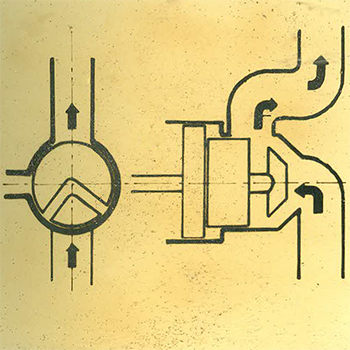
Using hot water is probably as old as human civilization itself. We get evidence of the use of hot water for baths in the "hamamas," or the public baths of old civilizations. Since then, hot water has been accepted as a "preferred luxury" for men. In the present, an electric geyser has become a "fair necessity," mainly because of the odd hours for a bath or wash, which are quite common for urban men. Also, the use of showers is so widely accepted for its function and economy that the old time consuming method of heating water first and then mixing it with cold water to a proper temperature for a bath is done away with, wherever it has become possible.
Now there are two types of geysers available, that have the possibility of shower connections. First is the storage type, which has the advantages of a proper shower connection, multiple taps, low wattage, and higher safety. But it is gradually becoming prohibitive because of its high cost, difficult maintenance, large area requirements, and difficulty in installation. The second is called the instant type electric geyser. This is getting wide acceptance primarily for its low price, small space requirement, and ease of installation. But it has the drawbacks of lesser electrical and mechanical safety and a difficult shower connection. Naturally, a product is needed that can have most of the advantages of both, mainly electrical and mechanical safety, shower connection, low price, lesser space requirement, and easy maintenance.

Design of Epidiascope
by Ramachandran Kadiru
Details >>
by Ramachandran Kadiru
We learn mostly through our eyes, and the approximate contributions of our sensory organs are given below:
-1% through taste
-2% through touch
-4% through smell
-10% through hearing
-83% through sight
This reveals that learning through sight so much overshadows learning through any and all other senses that no adjustment for error or incidents of exception could lessen the impact of sight on the process of learning. So it is vision that is the main avenue of perception, the eyes carry the burden of learning.
How much do we retain? The figure on the left shows the retention rate of read material. The term "reinforcement" in the second figure refers to a relearning of original learning in which the student spent additional time. The result is that the student's rate of retention was raised to about 50%.
But if the conceptual reinforcement was accomplished by the addition of visuals rather than by the repetition of reading, the retention rate of 50% could very well be more than coincidental. We do not think in words; our mind thinks in pictures. To communicate facts, figures, and ideas, visual presentation is more effective.
Design of Catering System in Aircrafts
by K. L. Munshi
Details >>
by K. L. Munshi
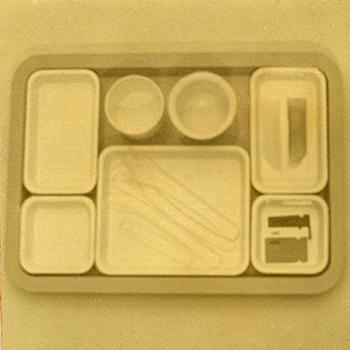
Good amount of work has already been done to improve passenger comfort in aircraft during flight. For improved passenger comfort, besides providing comfortable seats and a good environment and entertainment, the services inside aircraft have improved and should keep improving because of the newer problems creeping up daily in the air transportation of passengers. Services inside the aircraft include:
- Looking after passengers-old people, and children
- Keeping passengers informed and giving instructions from time to time audio and printed communication
- offering pillows and blankets
- Showing seats
- Various services and ensuring that there is no possibility of a complaint
- The distribution of food articles onto individual plates
- The serving of breakfast, lunch, tea, dinner, coffee, cigarettes, and drinks
- collection of these utensils back from the passengers
- storing them when they are filled or empty
- Storage of left-overs and disposable items like empty tin cans, bottles, etc.
- When the flight is long and nonstop, cleaning part or all of the cutlery for reuse during the flight is recommended.
- Heating or keeping food articles cool
Nowadays, it is clear that all international airline corporations are competing fiercely with one another and are essentially fighting for survival. With the introduction of Jumbos, the problem has become even more critical. For profitable operation of these aircraft, it is necessary that aircraft take off with a certain minimum percentage of the total capacity (breakeven point), depending on operation cost, fare structure, overheads, etc. Various airlines have already taken steps to attract passengers, such as slashing round-trip air fares. But there are limitations to it.
Housing System for Electronic Instruments
by Sashidhar Ravunni Menon
Details >>
by Sashidhar Ravunni Menon
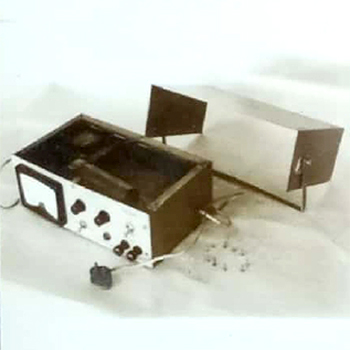
Electronics has come a long way in the last 25 years. It has helped man land on the moon, communicate over large distances in a fraction of a second, and be entertained by radio and television. Behind these visible and glamorous facades of electronics, but unknown to many, exist the drab and uninteresting laboratories where the marvels of electronics are born. And the core of these laboratories is the very vast array of electronic instruments that they possess.
Though very large amounts of money are spent to develop and perfect these instruments electronically, scant attention is paid to their construction. For example, not much effort has been put into making the fabrication of the instrument housings easier or cheaper. Then again, very little attention has been paid to the plight of the instrument repairers who have to dismantle the instruments.
Some of these difficulties have been corrected to some extent abroad, especially in the United States, England, and Germany, through standardization. This has been made possible principally because of the large size of the companies (General Radio, Hewlett-Packard, Marconi, and Siemens) and the resources at their disposal.
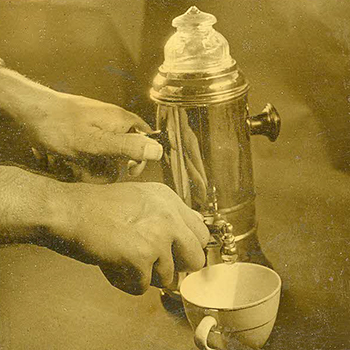
Design of Coffee Percolator
by V. K. Rao
Details >>
by V. K. Rao
The discovery of coffee is quite generally accredited to Africa, although the earliest cultivation is traced to southern Arabia. Coffee grew in Africa only in a wild state until fairly modern times, when it began to be developed there on a production basis. Coffee probably derives its name from the original Arabic Qahwah, indirectly through its Turkish form Kahveh, although some etymologists connect it with the name Kaffa, a town in southwest Ethiopia reputed to be the birthplace of coffee.
The origin of coffee is vague and obscure, but its history is rich in legend. One of the most accepted tales surrounding the discovery of coffee about 850 AD is that of Kaldi, an Arabian goat herder. Bewildered by the queer antics of his flocks, Kaldi is supposed to have eaten berries from the evergreen bush on which the goats were feeding and, overjoyed at the feeling of exhilaration that he experienced, has been pictured in legend as dashing off in excitement to proclaim his great find to the world. The physiological action of coffee in dissipating drowsiness was soon discovered and taken advantage of in connection with religious services of the Mohammedans, but the strictly orthodox or conservative section of the priesthood claimed that it was an intoxicating beverage and therefore prohibited by the Koran.