Product Design
Batch 1973-1975
(6 items)
Product DesignBatch 1973-1975
(6 items)
(6 items)

Premature Baby Incubator
by A. V. Pendse
Details >>
by A. V. Pendse
There are a number of Indian and foreign incubators that are now available in India. Still, I feel that there is a need for a redesign. Initially, let us try to understand what an incubator is and why it is used in the case of a premature baby. As the name suggests, an incubator is essentially a space enclosed with the facility of maintaining the desired artificial environment inside that enclosure.
A premature baby incubator artificially maintains womb temperature and provides safety from infection to a prematurely born infant. In the last few years, manufacturers in foreign countries have produced more and more sophisticated and advanced products, but in India, the first incubator was produced about five years ago, and all other Indian manufacturers copied the same design. There is no further development that has been done, nor has a study been done on an incubator to make it most suitable for the Indian climate and situation. This incubator at present costs a lot and is beyond the reach of the majority of hospitals. Recently, Dr. S.N. Deshpande, a civil surgeon from Kolhapur, studied this problem and developed an economical incubator.

Eddy Current Testing Equipment
by Ashok P. Dongre
Details >>
by Ashok P. Dongre
Eddy current tests provide a very important testing technique for metals. The technique is based on the principle that when a coil carrying A.C. is brought near or made to surround a metallic specimen, eddy currents are induced in that component, the magnitude and distribution of which depend on the geometry of the system and the conductivity of the specimen.
The coil impedence is affected by the presence of eddy currents. The impedence change is resolvable to an inductive component, which depends on the space relationship between the coil and specimen, and a resistive component, depending on the conductivity of the specimen.
Conductivity is closely related to the metallurgical structure of the specimen and its state of heat treatment. Thus, a separation of these two effects gives a sensitive testing technique for the metals. The use of eddy currents for nondestructive testing was pioneered by F. Forster and his associates in Germany, and further development was made in Britain by E.G. Stanford and in the USA by R. Hoschild and others.
Redesign of pH Meter
by E. Jyothi John
Details >>
by E. Jyothi John
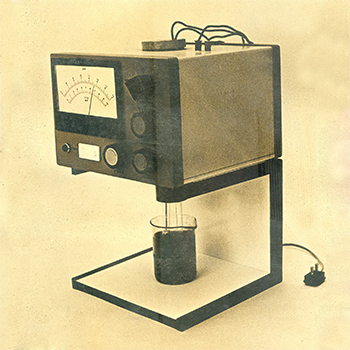
The dawn of modern civilization was characterised by the electronic industry. During the last few decades, electronics have made tremendous advances. Electronics did not spare to enter any of the human environments like laboratories, houses, etc. The majority of the laboratory instruments are mostly electronic in nature.
The pH metre is one such instrument among the vast array of electronic instruments. The adherence and determination of certain pH values are very important, particularly in catalytic processes. pH metres have varied applications, and the determination of the pH value of solutions is very important. Man always seeks ease and comfort and does not want to waste time and energy. Quick and accurate operation and reading of an instrument are essential for him.

Design of Electroencephalograph
by Jayanto Bose
Details >>
by Jayanto Bose
In the last couple of years, electronics in general and medical electronics in particular have made fantastic progress. Progress, which even a few years ago would have been unthinkable.
Miniaturisation has made it possible to bring under control a tremendous amount of power, computation, and highly complex controls to one’s fingertips in a package that may occupy only a portion of an ordinary desktop. A single operator can now control an atomic reactor, the production of a steel plant, and literally monitor the life of a human being in its physical aspects. The degree of complexity and compactness of medical electronic equipment has resulted in its wide use in hospitals today. An operation theatre, for example, is nowadays crammed with extremely sophisticated instruments, each of which performs a vital function.
Slide Rule for Schoolchildren
by S. R. Gursahani
Details >>
by S. R. Gursahani
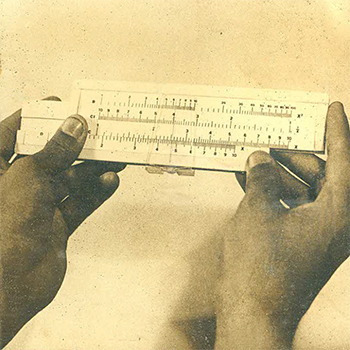
The side rule is an extremely useful instrument for making various kinds of calculations, especially multiplication and division. Its use in India is, however, restricted to technical colleges and, in some cases, to science students. The speed and accuracy with which these calculations can be done should lead to a much wider range of uses.
There are two factors that have probably prevented the use of the slide rule on a large scale.
1) The complexity of the slide rule scales. The errors that a learner makes might easily discourage him from using it.
2) The prohibitive cost of the instrument reduces its potential for widespread use.
The need, then, is to design a slide rule that is simple to use, has a few but easily understandable scales, and does not cost much. Such a slide rule, it is hoped, will be adopted in schools. With new and slightly complex courses being introduced at the school level (especially in higher secondary schools), there is an increasing need to make quick calculations. As it is, in the higher classes, students use log tables, which is quite a laborious process.
Design of Slide Projector
by Vijay Bapat
Details >>
by Vijay Bapat
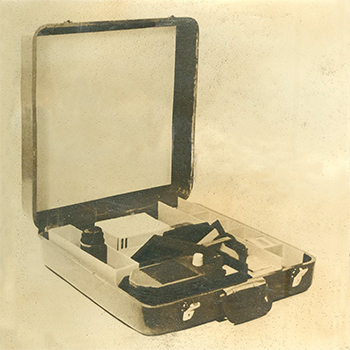
We learn mostly through our eyes. Every properly functioning human being transforms the visual signals that he receives from the outside into meaningful entities. Without the perceptual ordering of his sense responses into the image of things in space, man cannot orient himself, and without shaping his physical environment in accordance with these images, he cannot survive.
1% through taste
2% through touch
4% through smell
10% through hearing
83% through sight
This reveals that learning through sight overshadows learning through any and all other senses, so no adjustment for error, incidents, or exceptions could lessen the impact of sight on the process of learning.
We do not think in words or numbers, but our mind thinks in pictures or natural forms and shapes present in the surrounding environment. To communicate facts, figures, and ideas, visual presentation is the most effective medium.