Product Design
Batch 1995-1997
(3 items)
Product DesignBatch 1995-1997
(3 items)
(3 items)
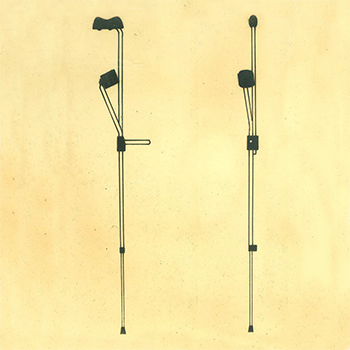
Transportation System for Lame Persons (Crutches)
by Ravi Poovaiah
Details >>
by Ravi Poovaiah
A handicap is a defect representing a decrease in or loss of ability to perform various functions, particularly those of the musculoskeletal system and sense organs. An external aid or device is essential for the mobility of a lame person. This would help him acquire more personal freedom and improve his physical functions. The number of lame people exceeds 7 million in our country. This denotes the gravity of the situation. The majority of these disabled people come from severely poor economic conditions. Hence, what they can afford to invest in and maintain as an external device is also the bare minimum.
Many parts of our man-made environment were not designed for any person at all but merely engineered down through time by new materials and methods. Architects, designers, and planners have taken advantage of the apparently unlimited ability of the human being to tolerate discomfort and inconvenience. The concept of fitting the activity of the equipment to meet the needs of the human being rather than vice versa is not very much applied anywhere, particularly in India.

Design of Indicating Stem for Domestic Gas Cylinder
by M. N. Narvankar
Details >>
by M. N. Narvankar
Keeping the home fires burning these days is no simple task, specifically when the housewife is at the mercy of our cooking gas suppliers. It is hard to fathom how the time taken to deliver a fresh cylinder ranges from a few hours to even a few days. Sometimes the agents are known to tell the customer that they could get their cylinder if they could collect it themselves.
Some consumers complain that their cylinders are underfilled. This can happen if there is connivance between the consumers and the delivery boys. These boys can take a cylinder used by a conniving customer for, say, 5 days and deliver it to another unsuspecting customer as "full." Meanwhile, the conniving customer gets another full cylinder (meant for someone else) for consideration, and this can continue depending on the degree of connivance. Hence, there is a need to develop an indicating device that will:
Give an indication (warning) about the quantity of gas left in the cylinder.
Check the quantity of gas in the cylinder when it is supplied.
It is believed that the gas companies have received several samples of pressure gauges or some other devices to ascertain when the gas is getting over, but none of these are said to be accurate. Certain electronic devices are said to help in this matter but are beyond the reach of the average customer. Hence, there is a pressing need to design an accurate and cheap indicating device to ascertain the quantity of gas in the cylinder.

Design of an Instant Shelter (Instant Structure)
by Sanjay Ektate
Details >>
by Sanjay Ektate
Shelter ranks among the three basic needs of a human being. Although architects have tried to improve the living conditions in buildings and houses for the last few centuries, few attempts were made to improve the conditions of smaller houses or huts, or those of instant shelters, or rescue shelters, as they are sometimes called. Instant shelters are needed for construction workers (such as those working on big dams, telephone lines, and high-tension lines), for military purposes where they can serve as semi-permanent posts (instead of the usual tents), or for refugees fleeing flood havoc, earthquakes, etc.
The attempt therefore is to design a shelter that can be used for a period of more than one year, which can be erected very easily with better living conditions (e.g., improved ventilation) than the usual huts, or design a system for building a better shelter complex.