Communication Design
Batch
(3 items)
Communication DesignBatch
(3 items)
(3 items)
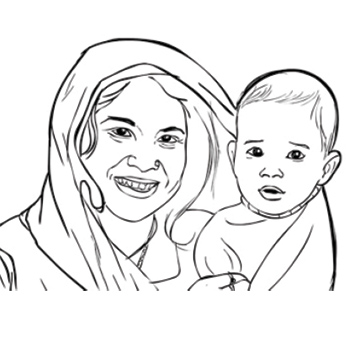
Redesign of Immunisation Card
by Prof. Mandar Rane
by Prof. Mandar Rane
Redesign of the immunisation card by Prof. Mandar Rane. The Universal Immunisation Programme (UIP), run by the Government of India, makes essential immunisation available for free to children between the ages of 0 to 5 years. The mother and child protection card that contains demographic and health information as well as the immunisation status of a child is an important part of UIP. For every child immunised under this program, there exists a home-based physical record as well as a clinic-side copy of the same. The language, content, and design of the immunisation card vary from state to state. Analysis of immunisation cards from three states—Bihar, Gujarat, and Maharashtra as well as contextual inquiries conducted at a primary healthcare centre in Mumbai revealed several issues faced by three types of stakeholders in the immunisation process: healthcare service providers, parents, and caregivers of the child. Surveyors and policy-makers also rely on information from such cards for gathering data about the population. The redesigned card addresses problems of comprehension, the needs of various stakeholders while entering and retrieving data, and practical issues such as the durability of the immunisation card.
Details >>
The Photographer The reality of imagination | Success story of Navi Mumbai Film on the sanitation project | Traditional Indian Art and Animation in India Exploring the roots for an Indian style
by Prof. Mazhar Kamran
by Prof. Mazhar Kamran
The Photographer and The Reality of Imagination projects were done by Prof. Mazhar Kamran. With the mystic poems of Rumi working as dialogues that the characters speak, "The Photographer" is a film that explores the realm of imagination and what it means to a person who, in order to create, lives much of the time on the boundary between the real and the imagined. The story is about a photographer who shoots a model one day, and it turns out she is visible only to him. He had walked into another time. "The Photographer" had its premiere on the Foundation Day of the Film and Television Institute of India, Pune. It was shown internationally at the Cannes Film Festival, Short Film Corner. The second project of Prof. Mazhar Kamran was the success story of Navy Mumbai Film on the Sanitation Project. Clean water and sanitation is a sustainable development goal of UN. To communicate the difference that modern sanitation methods can make to a city’s water and sanitation needs, the film presents the "success story" of Navi Mumbai in this context. Taking a cinematic approach, the film communicates without commentary or interviews, relying purely on visuals and sounds, with minimal text. The film was commissioned by the Asian Development Bank Institute, Tokyo. It will be used for advocacy and leadership-building programmes of ADBI. Another project of Prof. Mazhar Kamran was Traditional Indian Art and Animation in India Exploring the roots of an Indian style On the one hand, we have a rich heritage of traditional Indian art forms that are rooted in the different regions. They embody the culture of the people. The colours, the shapes and forms are distinct, and they tell equally rich stories of the people. On the other hand, we have a contemporary medium, Animation, born in modern times, it has roots in an industrial environment which is increasingly technology-driven. Between these two is a gulf, a rich space full of creative possibilities. What the research seeks to do is study this space systematically and formulate key concepts and ideas in this space. It seeks to articulate and codify all that is involved in the transformation of an art form from one tradition, one origin, into another, more contemporary form. The study will also reflect upon the issues—social, ethical, and aesthetic—that crop up when such a transformation happens.
Details >>
Art @IITB | National Salt Satyagraha Memorial Dandi | Learning from Nature and from the Indigenous Collaborative project with Bidyut Roy and Sandeep Manchekar | Understanding visual art traditions Collaborative projects with practitioners of indigenous art traditions
by Prof. Raja Mohanty
by Prof. Raja Mohanty
Prof. Raja Mohanty’s one of the best projects was Art @ IITB. IIT Bombay’s vision is to be a leading global technology university that provides a transformative educational experience to create leaders and innovators and generate new knowledge for society and industry". The arts enrich our aesthetic imagination and help to shape how we perceive ourselves and our surroundings. A visible display of works on the IIT Bombay campus that combine technical and artistic creativity could aid in the integration of education. This project envisaged a road-map for arts education at IIT Bombay that includes the creation of traditional and contemporary works of art on the campus; residencies, seminars, and talks by visiting artists; and mentorship to encourage students to develop an aesthetic sensibility. His other important project was the National Salt Satyagraha Memorial, Dandi. This memorial to the 80 marchers who accompanied Gandhi in upholding "Right against Might" was conceptualised by Prof. Kriti Trivedi. The beginning of an engagement with handloom weaving is an interesting "side effect" of this memorial. In 2019, Shivani Nayak, one of the graduating students from IDC School of Design, wove her own convocation scarf. The weaving initiative encourages more students to do the same. Learning from Nature and from the Indigenous Collaborative Project with Bidyut Roy and Sandeep Manchekkar project was a residency space for visiting faculty was created at Wighavali using local materials such as bamboo, mud, fired bricks, traditional terracotta tiles, and dried pipal leaves. This space is envisaged as an extension of classroom walls to spaces outside cities that enables students to come into contact with alternate realities and learn from indigenous ways of doing things and from nature. Raja Mohanty’s other important project was Understanding Visual Art Traditions. collaborative projects with practitioners of indigenous art traditions. The traditions studied included patachitra art from Orissa; Gond art from Madhya Pradesh; Madhubani from Bihar; and Pichhwai from Rajasthan. Collaborative projects took the shape of books for children and "grown-up" children! Ghanshyam Sharma from Nathdwara, Radhashyam Raut from Bhubaneswar, Durgabai, and Mansingh Vyam from Bhopal, and Sharwan Paswan from Mithila were the artists with whom the collaborative projects were done. "The Circle of Fate" published by Tara Books, Chennai, was shortlisted for the Anderson Prize, 2009. "The Enigma of Karma" was a sequel to this. "Machaan Masti", "On Inheritance", and "Cycle Ka Sapna" are some of the other learning materials for children that were created as the collaboration continued as a part of the Damroo Project, funded by the Navajbai Ratan Tata Trust.
Details >>