Product Design
Batch
(4 items)
Product DesignBatch
(4 items)
(4 items)
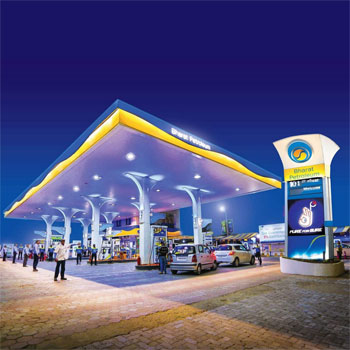
Retail Vision for Bharat Petroleum Corporation
by Prof. Ravi Poovaiah
by Prof. Ravi Poovaiah
Prof. Ravi Poovaiah from IDC IIT Bombay played a significant role in shaping the retail vision for Bharat Petroleum Corporation Limited (BPCL) through design and innovation. This project focused on transforming the retail experience at BPCL's fuel stations and establishing a strong brand identity, aligning with modern customer expectations and the corporation’s goals for expansion and modernization. The core objective of the Retail Vision project was to make BPCL's fuel stations more accessible and user-friendly for customers. Prof. Poovaiah and his team focused on improving the overall customer experience through design, making fuel stations more visually appealing and functional. This included rethinking station layouts, signage, and wayfinding to create a seamless and efficient experience. Prof. Poovaiah helped refining BPCL’s visual identity, including the development of consistent signage, logos, and brand colours across all retail outlets. The design emphasised clarity, ease of navigation, and the corporation’s commitment to providing quality services. The visual system created a strong brand recall for BPCL, allowing the corporation to stand out in the competitive market. One of the goals was to ensure that all BPCL stations had a uniform look and feel. This included the design of service counters, lighting, canopy structures, and the arrangement of pumps to ensure a cohesive and appealing appearance that aligned with BPCL's new vision. The Retail Vision project under Prof. Ravi Poovaiah’s guidance significantly contributed to BPCL’s transformation into a modern, customer-centric corporation. The new design language and infrastructure reflected a strong, unified identity while also setting the groundwork for future growth and innovation in services.
Details >>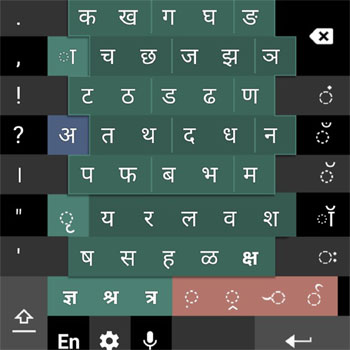
Swarachakra
by Prof. Anirudha Joshi
by Prof. Anirudha Joshi
Swarachakra is a popular virtual keyboard designed for Indian languages, created under the guidance of Prof. Anirudha Joshi from the Industrial Design Centre (IDC), IIT Bombay. The keyboard is specifically developed to address the challenges of typing in Indian scripts on mobile devices, which often require more complex input systems compared to the Roman alphabet used in English. Swarachakra supports several Indian languages, including Hindi, Marathi, Bengali, Tamil, Telugu, Kannada, Malayalam, and others. The keyboard uses a unique "chakra" layout, where each vowel or consonant is arranged in a circular (chakra) manner around the base character, making it easier for users to find the appropriate form of a letter or its combination. Indian scripts often require combining consonants with vowels or other consonants (e.g., ligatures). Swarachakra makes this process intuitive by organising all possible character combinations in proximity to the base character. Prof. Anirudha Joshi has a strong focus on human-computer interaction (HCI) and designing solutions for underserved user groups, particularly in the Indian context. The development of Swarachakra reflects his emphasis on creating technology that is culturally relevant and user-friendly for native language speakers.
Details >>
Keylekh: a keyboard for text entry in indic scripts
by Prof. Anirudha Joshi
by Prof. Anirudha Joshi
Prof. Anirudha Joshi and his team at the Industrial Design Centre (IDC), IIT Bombay designed Keylekh, a significant virtual keyboard, to facilitate text entry in Indian scripts on digital platforms. Like Swarachakra, Keylekh is aimed at addressing the challenges of typing in complex Indic scripts, but it adopts a slightly different approach to text input. Keylekh is based on a phonetic typing system. Users can type Indic characters using Roman alphabet equivalents, which are then automatically converted into the corresponding characters in the target Indian script. This helps users who are familiar with the Roman script but may not be accustomed to typing in native scripts. The keyboard supports a wide range of Indian scripts, making it versatile for users across India who speak and write in different languages like Hindi, Marathi, Bengali, Tamil, Telugu, Kannada, and others. As users type in phonetic Roman letters, the system dynamically converts them into the correct Indic script, allowing users to see the text in real-time. This immediate feedback ensures that users can quickly correct mistakes and learn the mapping between the Roman and Indic characters. Keylekh stands out as an innovative approach to digital text entry in Indian languages. It simplifies the typing process for a broad user base, particularly for those more familiar with Roman characters than complex Indian scripts. This keyboard is part of Prof. Anirudha Joshi’s broader mission to make technology accessible to underserved communities by designing culturally appropriate and user-friendly interfaces.
Details >>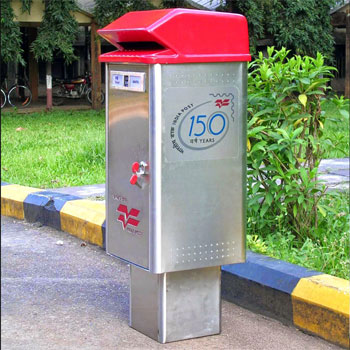
Design of a Post Box
for India Post
by Prof. B. K. Chakravarthy
by Prof. B. K. Chakravarthy
The "Design of a Post Box for India Post" is an important design project led by Prof. B. K. Chakravarthy from the Industrial Design Centre (IDC), IIT Bombay. The project aimed to redesign and modernise the post boxes used by India Post, ensuring they were functional, durable, and visually aligned with the evolving urban and rural landscapes of India. The redesign focused on improving usability while maintaining the iconic and familiar look of the post box. One of the primary goals of the project was to make the post boxes more user-friendly. The height, angle, and placement of the mail slot were optimised for ease of use, ensuring that people of varying heights, including children and elderly citizens, could comfortably deposit letters. India’s diverse and extreme weather conditions—ranging from heavy monsoons to scorching summers—necessitate the use of weather-resistant materials. The redesigned post boxes were constructed with durable, rust-resistant materials to withstand harsh outdoor environments, ensuring long-term usability and reducing maintenance costs. The redesigned post boxes for India Post were successfully implemented across the country, serving as a vital tool in connecting people, especially in rural and remote areas.
Details >>