Evolution of Coin Design in India
(1000-901) B.C.E
(1 items)
(600-501) B.C.E
(1 items)
(500-401) B.C.E
(1 items)
(400-301) B.C.E
(1 items)
(300-201) B.C.E
(1 items)
(200-101) B.C.E
(1 items)
(1-99) C.E
(1 items)
(100-199) C.E
(1 items)
(200-299) C.E
(1 items)
(300-399) C.E
(1 items)
(500-599) C.E
(1 items)
(800-899) C.E
(1 items)
(900-999) C.E
(1 items)
(1000-1099) C.E
(1 items)
(1200-1299) C.E
(4 items)
(1300-1399) C.E
(1 items)
(1500-1599) C.E
(4 items)
(1600-1699) C.E
(2 items)
(1800-1899)
(4 items)
(1900-1946)
(6 items)
(1947-1959)
(9 items)

(1960-1979)
(1 items)
(1980-1999)
(4 items)
(2000-2019)
(1 items)
Evolution of Coin Design in India
(1000-901) B.C.E
(1 items)

Puranas, old Karshapanas or Pana
Ancient India
Ancient India
Mahajanapada kingdoms (republic kingdoms) of ancient India included Gandhara, Kuntala, Kuru, Panchala, Shakya, Surasena, and Saurashtra. The coins of this period were punch-marked coins called Puranas, old Karshapanas, or Panas. Several of these coins had a single symbol; for example, Saurashtra had a humped bull, and Dakshin Panchala had a Swastika. Others, like Magadha, had several symbols. These coins were made of silver of a standard weight but with an irregular shape. This was gained by cutting up silver bars and then making the correct weight by cutting the edges of the coin. They are mentioned in the Manu, Panini, and Buddhist Jataka stories and lasted three centuries longer in the south than the north (600 BCE–300 CE).
Details >>(600-501) B.C.E
(1 items)

Shatamana bent bar
Ancient India
Ancient India
This is a silver bent-bar and punch-marked coin from the Janapada (Vedic era) of Gandhara, one of the biggest kingdoms in ancient India. The term shata-mana translates to 100 ‘manas’, a unit of measurement, and these were in circulation in the 6th century BCE. The characteristic feature of all Gandharan shatamanas was the six-armed round symbol stamped on either end of the bar. Slowly, the concept of punchmarked coins spread beyond Gandhara to the south and was later minted in many other regions of northern and central India. The Shatamana coinage system continued for a long period, probably until Chandragupta Maurya conquered Gandhara in 300 BC. After that, short-debased, silver-plated, and copper-bar issues were minted. The original silver Shatamanas, though, are extremely rare coins in India.
Details >>(500-401) B.C.E
(1 items)

Saurashtra die struck coins
Ancient India
Ancient India
Saurashtra Janapada coins are probably the earliest die-struck figurative coins from ancient India, dating from 450 to 300 BCE, and are also perhaps the earliest source of Hindu representational forms. Most coins from Surashtra are approximately 1 gramme in weight. Rajgor believes they are therefore quarter karshapanas of 8 rattis, or 0.93 gm. Mashakas of 2 rattis and double mashakas of 4 rattis are also known. The coins appear to be uniface in that there is a single die-struck symbol on one side. However, most of the coins appear to be overstruck over other Surashtra coins, and thus there is often the remnant of a previous symbol on the reverse, as well as sometimes under the obverse symbol as well. The Surashtra Janapada was located in modern Saurashtra, in the state of Gujarat. It is mentioned in both the Ramayana and the Mahabharata. Indeed, the city of Dwarka, where Lord Krishna ruled, is in northern Saurashtra, although the Surashtra janapada may have been located only in the southern part of the peninsula. Most Surashtra coins are found in the south, in Junagadh district. Surashtra was absorbed into the Mauryan empire by Chandragupta Maurya.
Details >>(400-301) B.C.E
(1 items)
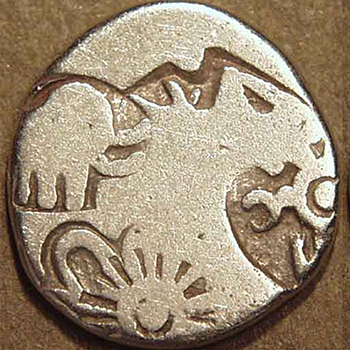
Mauryan Empire coins
Mauryan Empire
Mauryan Empire
Maurya emperor Chandragupta Maurya came up with the punch-marked coins, which were minted in silver, gold, copper, or lead. Indo-Greek Kushan kings introduced the Greek custom of engraving portraits on the coins. Chanakya, prime minister to the first Mauryan emperor, mentioned the minting of coins such as Rupyarupa (silver), Suvarnarupa (gold), Tamararupa (copper), and Sisarupa (lead) in his Arthashastra treatise. The major changes that took place in the economic sphere during Mauryan rule were increasing the use of coins, improving trade and commerce, improving communication and transportation, and so on. Mauryan coins were similar to the punch-mark silver coins of the Early Kingdoms. But Mauryan coins generally had five punches and also had a sun symbol in those punches. The coins issued by the Mauryans are mostly silver and a few copper pieces of metal in various shapes, sizes, and weights. They also have one or more symbols punched on them. The symbols included the elephant, the tree in the railing symbol, and the mountain. Some were geometrical symbols.
Details >>(300-201) B.C.E
(1 items)

Uninscribed Cast Copper Coins
Ancient India
Ancient India
They have been found in most parts of the subcontinent except the far south. Some types have a fairy-wide distribution, while others (such as those found at Ayodhya and Kaushambi, which seem to have been issued in the last 3rd or early 2nd century BCE) have a more restricted range of circulation. Kaushambi, uninscribed, cast copper unit Tree in railing in centre, wheel above Nandipada to left, swastika above Ujjaini symbol to right, and six-peaked hill at bottom Rev: Lanki bull walking to left, four nandipadas above in front of a triangular-headed standard. Bopearachchi & Pieper These coins were made by melting metal and pouring it into clay or metal moulds.
Details >>(200-101) B.C.E
(1 items)

Svarna coins
Ancient India
Ancient India
Svarna coins have been discovered in Gandhara. In addition to being a name for gold coins (referred to as Svarna Rupa), svarna was also a weight standard used in ancient India that supplanted the Purana or Dharana. One svarna or karsha was equal to 80 rattis in Arthashastra (based on the 1 masha = 5 ratti norm).
Details >>(1-99) C.E
(1 items)

Kushan coins
Kushan Empire
Kushan Empire
The Indo-Greek kings introduced Greek types, among them the portrait head, into the Indian coinage, and their example was followed for eight centuries. The Indo-Greek kings introduced Greek types, among them the portrait head, into the Indian coinage, and their example was followed for eight centuries. The extensive coinage of the Kushan Empire (1st–3rd centuries CE) continued to influence the coinage of the Guptas (320–550 CE) and the later rulers of Kashmir. Kushan coins had the diademed, helmeted bust of the king on one side and the king’s favourite deity on the reverse.
Details >>(100-199) C.E
(1 items)
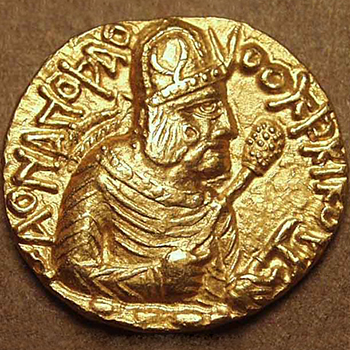
Kanishka and Huvishka
Kushan Dynasty
Kushan Dynasty
Huvishka's gold coins almost always show the king's bust facing left; this rare type has the bust facing right (Göbl obverse type I). Otherwise, the coin is quite representative of Huvishka's dinars. Their weight is almost always slightly short of 8 grammes, the diameter tends to be right around 20 mm, and the die axis is normally right around 12 o'clock. The obverse legend is also pretty standard, with only slight variations in letter form, spelling, and the break point for the legend around the king's crown. The image above features a crowned, diademed bust of a monarch clutching an elephant goad and a mace, a Bactrian legend surrounding it, and the solar deity Mithra standing with his back to us and his hands outstretched in blessing.
Details >>(200-299) C.E
(1 items)
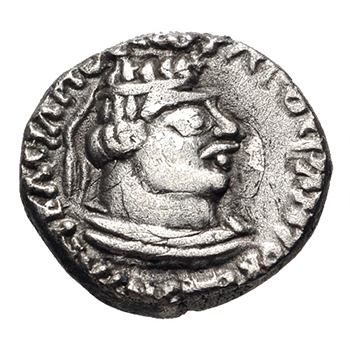
Coin of Indo-Scythian Northern Satrap Rajuvula
Northern Satrap Dynasty
Northern Satrap Dynasty
These coins have been found in most parts of the subcontinent, except in the far south. Some types have a fairy-wide distribution, while others (such as those found at Ayodhya and Kaushambi, which seem to have been issued in the last 3rd or early 2nd centuries BCE) have a more restricted range of circulation. Kaushambi, uninscribed, cast copper unit Tree in railing in centre, wheel above nandipada to left, swastika above the Ujjaini symbol to right, and six peaked hills at the bottom. Rev: Lanki bull walking to left, four nandipadas above in front of triangular-headed standard. Bopearachchi & Pieper: These coins were made by melting metal and pouring it into clay or metal moulds.
Details >>(300-399) C.E
(1 items)

The Gupta coins
Gupta dynasty
Gupta dynasty
The Gupta Empire produced large numbers of gold coins depicting the Gupta kings performing various rituals. This tradition of intricately engraved coins continued until the arrival of the Turkish Sultanate in North India. The Gupta coins, with their many varieties and inscriptions in Sanskrit, are among the finest India has produced.
Details >>(500-599) C.E
(1 items)

Indo-Sasanian coinage
Gupta Dynasty
Gupta Dynasty
There is a whole category of Indian coins in the "Indo-Sassanian style", also sometimes called Gadhaiya paisa, that were derived from the Sasanian coinage in a rather geometric fashion among the Gurjaras, Pratiharas, Chaulukya-Paramara, and Palas from circa 530 CE to 1202 CE. Typically, the bust of the king on the obverse is highly simplified and geometric, and the design of the fire altar, with or without the two attendants, appears as a geometrical motif on the reverse of this type of coinage. It is possible to see a progressive degradation and stylization of the original Sasanian design in ways that vary according to the region where it was current. Typically, the bust of the king on the obverse is highly simplified and geometric, and the design of the fire altar, with or without the two attendants, appears as a geometrical motif on the reverse of this type of coinage.
Details >>(800-899) C.E
(1 items)

Chola Empire
Chola Empire
Chola Empire
The coins of the Chola Empire bear similarities with other South Indian dynastic issue coins. Chola coins invariably display a tiger crest. The appearance of the fish and bow on Chola issue coins that were emblems associated with the Pandyas and Cheras, respectively, suggests successful political conquest of these powers as well as co-option of existing coin issuing practices.
Details >>(900-999) C.E
(1 items)

Rajput Kingdoms
Gahadavala Dynasty
Gahadavala Dynasty
The Gahadavala dynasty (IAST: Gahadavalas) also known as the Gahadavalas of Kannauj, was a Rajput dynasty that ruled parts of the present-day Indian states of Uttar Pradesh and Bihar during the 11th and 12th centuries. Their capital was located at Banaras (now Varanasi) in the Gangetic Plains, and for a brief period, they also controlled Kannauj. The coins of various Rajput princes's ruling in Hindustan and Central India were usually of gold, copper, or billon, very rarely silver. These coins had the familiar goddess of wealth, Lakshmi, on the obverse. In these coins, the goddess was shown with four arms rather than the usual two arms of the Gupta coins; the reverse carried the Nagari legend. The seated bull and horseman were almost invariable devices on Rajput copper and bullion coins.
Details >>(1000-1099) C.E
(1 items)

Eastern Ganga Empire
Eastern Ganga Dynasty
Eastern Ganga Dynasty
The Eastern Ganga coinage consisted of gold fanams. The obverse typically depicts a couchant bull along with other symbols. The reverse features a symbol that represents the letter sa (for samvat, which means year) flanked by elephant goads or an elephant goad with a battle axe, along with a number below, which depicts the regnal year (anka year) of the reigning monarch. Some coins also carry the legend sri rama on the reverse above the letter sa. An interesting aspect of the Eastern Ganga coin dates is that these coins may be the earliest Hindu coins dated using decimal numbers. Earlier dated coins, such as those of the Western Satraps, the Guptas, etc., used the old Brahmic numbering system with separate symbols representing each of the single digits, separate symbols representing two-digit multiples of ten, such as 20, 30, 40, and so on, and further separate symbols representing three-digit numbers such as 100, 200, etc. Thus, a number like 123 was written as 100-20-3. But the Eastern Ganga coins were written using the symbols for the single digits, with the position of the number indicating the value, such as tens or hundreds, thus effectively using the zero-place-holder system.
Details >>(1200-1299) C.E
(4 items)

Gadahara Simha
Ahom Dynasty
Ahom Dynasty
The Ahom Kingdom was founded in the 13th century by migrants from northeastern Burma who conquered the old kingdom of Kamarupa. The kingdom was able to withstand invasions from the Bengal sultanate and even the Mughal empire, although the king was forced to pay some tribute, and Aurangzeb even briefly issued coins in Assam. Eventually, the kingdom was defeated by invading Burmese armies in 1821–22. At that point, the British stepped in and made Assam a British protectorate in 1825. The earliest coins from the Ahom kingdom date from the 15th century. Originally, the coins were round, but in the 16th century, the shape of the coins was made octagonal, supposedly because the Yogini Tantra mentions that Kamarupa is eight-sided. The octagonal shape and the long series make these coins highly popular with collectors.
Details >>
Ghaznavids
Ghaznavid Dynasty
Ghaznavid Dynasty
A fascinating coin in that it is one of the few bilingual coins from this period, showing the Islamic professions of creed in both Arabic and Sanskrit! This variety has al-qadir above and billah to the left on the obverse. Also, the reverse margin reads: avyaktiya name ayam tankam hato mahamudapura samvati. Although the first Muslim conquerors in India were the Habbarids of Sind and the Amirs of Multan, their effect on the country was not very far-reaching. The Ghaznavids were a Turkic dynasty that started out as regional governors for the Samanids in the area of Ghazni in modern Afghanistan. They became independent in AH 389 (= 999 CE) and expanded their realm into northern India. Mahmud, the son of the founder of the dynasty, embarked on a major military campaign, as a result of which he became the ruler of most of present-day Afghanistan, Iran, Pakistan, and northwestern India. The Ghaznavid dynasty succumbed to the Ghorids in the late 12th century.
Details >>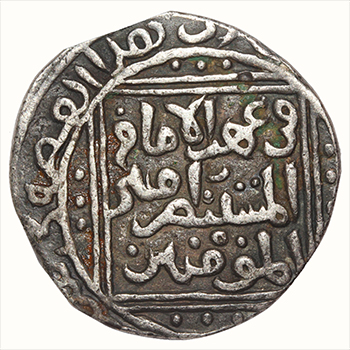
Razia Sultan, Silver Tanka
Mamluk Dynasty
Mamluk Dynasty
Razia Sultana was one of the few queens regnant in the history of India and thus one of the few women to issue coins. This coin was minted during the early days of the reign of an exceptional leader who steered the Delhi Sultanate from 1236 to 1240. Razia Sultan (she was not a fan of 'Sultana') was the daughter of Iltutmish of the Mamluk dynasty and the first woman monarch of this land—and among very few of her number in the world. Coins of Razia are found in silver and bronze; one gold coin of Bengali style is also known. Silver tankas were issued from both Bengal (Lakhnauti) and Delhi. Initially, she issued coins from Delhi in the name of her father, Iltumish, citing the title Nasrat, i.e., the female title of Nasir.
Details >>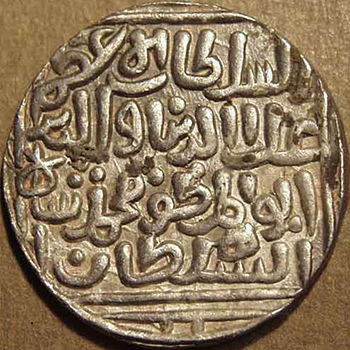
Alauddin Khalji coins
Khalji Dynasty
Khalji Dynasty
Ala ud din Khliji issued coins in gold, silver, copper, and billon. Gold and silver tankas issued by him are very common and were struck at three places: Delhi, Dar al-Islam, and Deogir. He also struck some square tankas in both metals, but they did not have the mint name inscribed on them. Alauddin Khalji minted coins with the legend Sikander Sani. Sikander is Old Persian for 'victor', a title popularised by Alexander. While sani is Arabic for second, the coin legend (Sikander-e-Sani) translates to 'Second Alexnder' in recognition of his military success. His coins omitted the mention of the Khalifa, replacing it with the self-laudatory title Sikander-us-sani Yamin-ul-Khilafat.
Details >>(1300-1399) C.E
(1 items)
Muhammad bin Tughluq coins
Tughlaq Dynasty
Tughlaq Dynasty
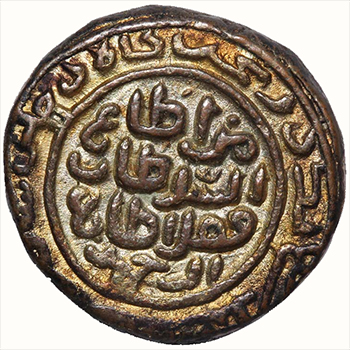
When there was a lack of gold and silver, Muhammad Bin Tughlaq introduced the copper coin as currency. He established a minister to watch out for counterfeiting since he knew how important token money was. This plan, however, ran into difficulties because the coins had no royal seals and simply new currency usage inscriptions. By the time the famed traveller Ibn Battuta visited the Sultanate in 1334, all copper money had been destroyed. 'Struck as a current tanka in the time of the servant expectant of Divine Mercy Muhammad Tughlaq' is in the translation of the inscription on the obverse. He who sincerely obeys the sovereign obeys the merciful one, according to the reverse, and Takhtgah is the name of the mint.
Details >>(1500-1599) C.E
(4 items)
Vijayanagara empire coins
Tuluva Dynasty
Tuluva Dynasty
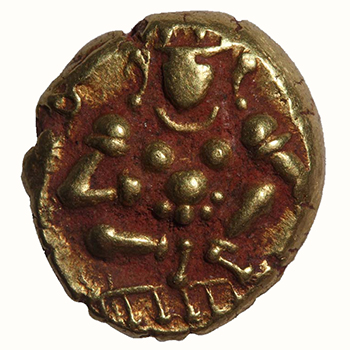
The Vijayanagara empire came into existence around 1336 AD, founded by Hakka and Bukka, who were (according to some sources) two revenue officials serving under Kakatiya rulers. The empire spanned three centuries and produced four dynasties: Sangama, Saluva, Tuluva, and Aravidu. Krishnadevaraya, considered to be one of the greatest of the Vijayanagara kings, belonged to the Tuluva dynasty. He restored peace, rearranged the administration, and commanded the allegiance of previously independent kingdoms. When he visited the Tirupati temple to perform the kanakabhishekam (a sacred ritual where an idol is showered with gold), he minted special gold coins just for the occasion. On the front of this coin, you can see Lord Balakrishna seated in the regal Lalitasana pose. The reverse features the name of the king in Nagari—it reads, Shri Pratapa Krishnaraya. Obverse The king is seated with folded legs.
Details >>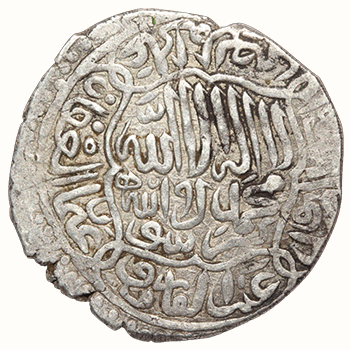
Shahrukhi Coin
Mughal Dynasty
Mughal Dynasty
Babur, the founder of the Mughal dynasty, was a descendant of Timur and Genghis Khan. One of the ways in which he pledged his allegiance was by introducing the Shahrukhi denomination of coin to the Subcontinent. Shahrukhis were flat, round silver coins first issued by the Timurid ruler Shah Rukh in the 15th century. These coins had a good run in India under Humayun and Akbar until they were replaced by the rupee. Babur was born a prince in Ferghana, present-day Uzbekistan, with ambitions to rule Samarkand. When he failed to hold onto his throne there, he came eastward and, after the Battle of Panipat in 1526, invaded Agra and Delhi. This silver coin weighs nearly 5 grammes, and on the obverse it features the Kalima (the Islamic invocation to Allah) and the names of the four caliphs. On the reverse, it has the date the coin was minted (Hijri year 910, 1504–1505 AD), the mint town (Badakhshan), and the name of the emperor. Generally speaking, Shahrukhis issued by Babur would carry the lengthy legend of: Al-Sultan Al-Azam Wa Al-Khakan Al-Mukarram Zahiruddin Muhammad Babur Badshah Ghazi. The obverse has a cartouche inside that is inscribed Kalima Reverse. The reverse mentions the date, mint town, and name of the emperor.
Details >>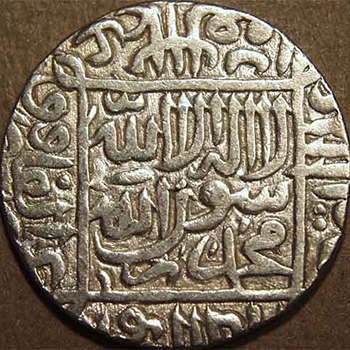
Sher Shah Suri
Sur dynasty
Sur dynasty
Sher Shah was one of the greatest Muslim rulers in India. He served in the Lodi military, ending up in Bihar and eventually gaining a position of power there. When the Mughals defeated the Lodis, the sultanate started to fragment, and Sher Shah took the opportunity to consolidate his power and even extend it east into Bengal and west into what is now Uttar Pradesh. In his short reign of 7 years (1538-45), Sher Shah transformed northern India. He built four major roads criss-crossing his empire and provided them with fruit trees all along, with rest stops and wells at periodic intervals. He also minted a substantial amount of coin, introducing the 11 gm silver rupee to replace the 10 gm billon tanka and also providing copious copper coinage based on the paisa. The provision of roads and coins combined to facilitate trade, and the economy must have boomed. The monetary reforms persisted after the Suri reign ended; even today, India's currencies are the rupee and paisa. The system of tri-metalism that came to characterise Mughal coinage was introduced by Sher Shah Suri. While the term rupya had previously been used as a generic term for any silver coin, during his rule the term rupee came to be used as the name for a silver coin of a standard weight of 178 grains, which was the precursor of the modern rupee. Shar Shah died in an unfortunate accident when a rocket his own forces had fired rebounded onto a pile of ammunition near where he was situated. He was mortally wounded in the blast.
Details >>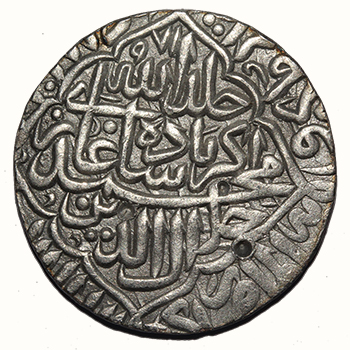
Coins of Akbar
Mughal Dynasty
Mughal Dynasty
This silver coin was issued by Akbar, minted at Agra, and is known as the ‘Kalima type’. Inscribed on both sides, the coins consist of the ‘Kalima’ (Islamic affirmation of faith) on the obverse and the name and title of the issuer, date, and mint on the reverse. On the obverse side of the Kalima type of coin is inscribed the Islamic affirmation of the faith, "La Ilaha Illallahu Muhammadur Rasulullah", along with the names of the four caliphs: Abu Bakr, Umar, Usman, and Ali. In the later part of Akbar’s reign, his coinage changed considerably. The Kalima was dropped from the obverse and replaced by "Allahu Akbar Jalla Jalalhu" (God is great; bright is his glory). And the reverse saw the deletion of the king’s name and title. The Ilahi year and the Persian date remained.
Details >>(1600-1699) C.E
(2 items)
Jahangir coins
Mughal Dynasty
Mughal Dynasty
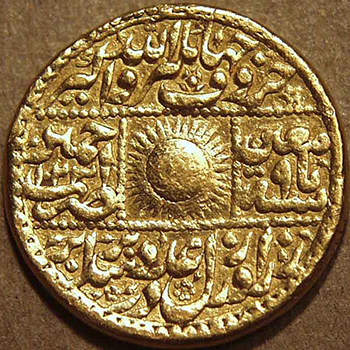
Jahangir was the son of Akbar and his Rajput queen, Princess Jodhabai of Amber. He was possibly the greatest patron of the fine arts among the Mughal emperors, and he took a great deal of personal interest in them. Jahangir released a lovely series of gold and silver coins depicting the zodiac's twelve signs. From his own entry in his autobiography, Tuzk-e-Jahangiri, it is known where Jahangir got the idea for his zodiac series. Thus, the sign of the zodiac was substituted for the month in which the coin was minted. The enthroned Jahangir is seen holding a wine goblet on one side of this coin, Gold Mohur, Ajmer, while the Radiate Sun is depicted on the other, surrounded by legends in four compartments.
Details >>
Maratha Empire coins
Maratha Empire
Maratha Empire
The Vijayanagar Empire's Huns served as inspiration for the Maratha's gold coinage. During Shivaji Maharaj's coronation in the year 1674, the gold huns of Shivaji Maharaj were issued. Chhatrapati Shivaji Maharaj issued a large number of copper coins, popularly known as Shivrai. 'Sri Raja Shiv' was written in devanagari on the coin's obverse. 'Chatrapati' was written in Devanagari on the coin's reverse. For the general public, copper coins were produced. There were also a very small number of Shivrai Hon gold coins produced.
Details >>(1800-1899)
(4 items)

1/12 Anna - King William IV & Queen Victoria
British India
British India
One of the last coins that may have been produced in the East India Company's name was this meagre 1 paise or quarter-anna piece dated 1858. Along with the rupee, the anna was taken directly from the Mughal monetary system. One rupee is equal to 64 paise, or sixteen annas. The EIC's coat of arms, which includes two lions and the Cross of St. George, which also appeared on their flag, is depicted on the front of the coin. Their motto, AUSP: REGIS ET SEN: ANGLIA, which translates to "by the Command of the King and Parliament of England," is written below on the ribbon. The coin's value is written in both Persian and English on the reverse.
Details >>
1/4 Rupee - Victoria
John Thomas Smith | British India
John Thomas Smith | British India
It was a coin from the ¼ Rupee-Victoria series issued by the East India Company in 1840. It was minted in Bombay, Calcutta, and Madras. In 1840, these were replaced by coins with an image of Queen Victoria, but the design otherwise remained the same. The obverse features Queen Victoria's head, facing left, a continuous English legend, and a toothed rim. The coin's reverse features an English legend, a toothed rim outside of the wreath, and the value written in both English and Urdu.
Details >>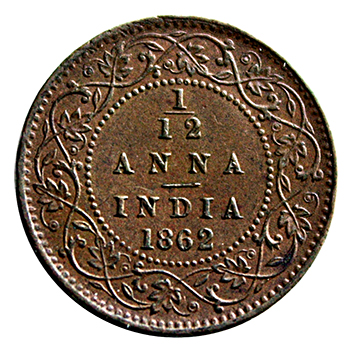
1/12 Anna - Victoria
William Wyon | British India
William Wyon | British India
The next set of coins was minted in 1862 and had significant changes: the East India Company was replaced by 'India'. The image of Queen Victoria was also changed, showing her in a regal robe with a crown. The obverse features a crowned bust of victoria on the left, and the reverse features value and date within a beaded circle and wreath.
Details >>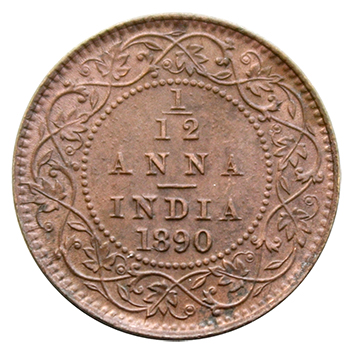
1/12 Anna - Victoria
William Wyon | British India
William Wyon | British India
In 1877, Victoria was declared the Empress of India, and her title on Indian coins changed as a result. This last design continued until 1938, with only the image of the ruler changing. Over this entire period, the weight of the Indian rupee and its purity remained constant at 11.66 grammes and 91.7%, respectively. Obverse
Crowned bust of Victoria facing left, with the reverse showing value above denomination, dividing line, country, and date—all within a beaded circle. Ornate intertwined leaf patterns surround.
Details >>(1900-1946)
(6 items)

1/2 Anna - Edward VII Pattern
George William de Saulles | British India
George William de Saulles | British India
On the front, it shows Edward VII, King and Emperor, while on the reverse, it shows "INDIA 1 AN NA 2 1908". George William de Saulles designed the obverse of coins of the United Kingdom and its colonies under Queen Victoria and King Edward VII, and these coins were designed with a scallop edge.
Details >>
1/12 Anna - Edward VII
George William de Saulles | British India
George William de Saulles | British India
The 1/12 Anna-Edward VII coin features a bust of Edward VII looking to the right on the obverse and the denomination and date enclosed in a wreath and a bead circle on the reverse.
Details >>
1/12 Anna - George V
Edgar Bertram Mackennal | British India
Edgar Bertram Mackennal | British India
The 1/12 Anna-George V coin features Crowned head of George V facing left on the obverse, and the denomination and date within a circle of beads, wreath surrounds any mintmark below the date on the reverse.
Details >>
1/4 Anna - George VI
Percy Metcalfe | British India
Percy Metcalfe | British India
The 1/12 Anna-George V coin features Crowned head of George V facing left on the obverse, and the denomination and date within a circle of beads. A wreath surrounds any mintmark below the date on the reverse. Edgar Bertram MacKennal was the coin's engraver, and these coins were in use from 1912 until 1936.
Details >>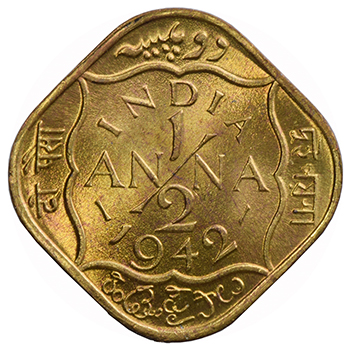
1/2 Anna - George VI
Percy Metcalfe | British India
Percy Metcalfe | British India
This coin, ½ Anna-George VI, had an unusual square design. It was struck with nickel-bronze during the Second World War. One side of this coin shows King George VI crowned head left, an English legend, and a toothed rim, and the other side shows the denomination and date within a decorative outline and the value in four Indian languages outside the border: Urdu, Bengali, Telugu, and Devnagari within a toothed rim.
Details >>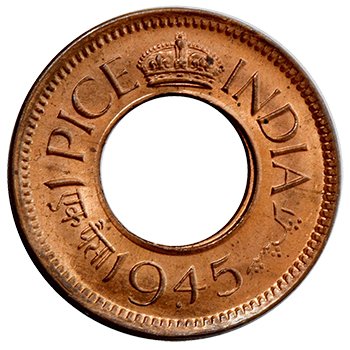
1 Pice - George VI
Albert Pearson Spencer | British India
Albert Pearson Spencer | British India
These are the one pice coins from British India. One side of this coin shows King George VI's crown with the year and denomination in both Indian and English. The other side shows a decorative outline.
Details >>(1947-1959)
(9 items)
1 Rupee - George VI
Percy Metcalfe | British India
Percy Metcalfe | British India
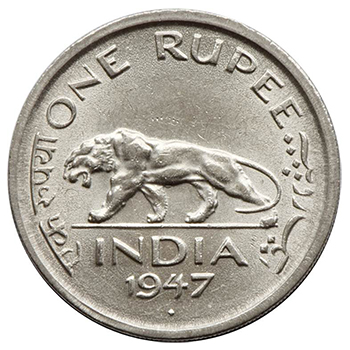
The 1 rupee (George VI) coin featured a circular pattern. This coin's left side features the crowned head of King George VI, while its right side displays the value, year, and denomination in Indian characters with a tiger in the centre.
Details >>
1 Pice
Government of India
Government of India
The 1 Pice coin featured a circular pattern. This coin's obverse side features the Ashoka Lion Capital, while its reverse side displays a prancing horse facing left. In this coin, they used both Devanagari and Latin.
Details >>
1/2 Anna
Government of India
Government of India
The ½ Anna coin featured a rhombus pattern. This coin's obverse side features the Ashoka Lion Capital, while its reverse side displays Zebu with the denomination written in Latin and Devanagari.
Details >>
1 Anna
Government of India
Government of India
The 1 Anna coin had a nickel-and-copper scalloped edge design. The Ashoka Lion Capital is depicted on the coin's obverse side, while Zebu and the value are printed in both Latin and Devanagari on the reverse.
Details >>
2 Annas Pattern
Government of India
Government of India
The 2 Annas coin had a nickel-and-copper composition with a rhombus design. The Ashoka Lion Capitol within a circle is depicted on the coin's obverse side, while a peacock and the value printed above and date are below. The scripts used in this coin are Latin and Devanagari.
Details >>
1/4 Rupee
Government of India
Government of India
The ¼ rupee coin had a nickel composition with a round design. The Ashoka Lion pedestal is depicted on the coin's obverse side, while grain sprigs flank the denomination and "Chaar Aana" (Four Annas) in Devnagari is printed on the reverse side.
Details >>
1/2 Rupee
Government of India
Government of India
The ½ rupee coin had a nickel composition with a round design. The Ashoka lion capitol and legend in English surrounds are depicted on the coin's obverse side, and on the reverse side shows Value flanked by stalks of wheat, date below, and the legend 'Aadha Rupya' in Devnagari.
Details >>
1 Rupee
Government of India
Government of India
The 1 rupee coin had a nickel composition with a round design. The state emblem of India and country name are depicted on the coin's obverse side, while face value and year are depicted in reverse. The scripts used in this coin are Latin and Devanagari.
Details >>
1 Naya Paisa
Government of India
Government of India
The 1 naya paisa coin had a bronze composition with a round design. The Ashoka lion capitol with the country name on both sides is depicted on the coin's obverse side, while the denomination above the date and "Rupye ka souva bhaag" and "Naya Paisa" in Devanagari are in reverse.
Details >>(1960-1979)
(1 items)

2 Paise
Government of India
Government of India
This 2-paise coin had an aluminium composition with a scalloped design. The Ashoka lion capitol is depicted on the coin's obverse side, while the denomination and date are in reverse.
Details >>(1980-1999)
(4 items)

10 Paise
Government of India
Government of India
This 10-paise FAO coin had an aluminium composition with a scalloped design. The Asoka lion pedestal is depicted on the coin's obverse side along with the denomination below, while the grain sprig within the stylized sun design is in reverse.
Details >>
20 Paise
Government of India
Government of India
This 20-paise coin had an aluminium composition with a hexagonal design. The Ashoka lion capitol is depicted on the coin's obverse side, while the denomination and date are in reverse.
Details >>
25 Paise
Government of India
Government of India
This 25-paise coin had a stainless-steel composition with a round design. The Ashoka lion capitol is depicted on the coin's obverse side along with the denomination given above, while the Indian rhinoceros are facing left with the date above.
Details >>
50 Paise
Government of India
Government of India
This 50-paise coin had a stainless-steel composition with a round design. The large denomination at the bottom with the three lions symbol above is depicted on the coin's obverse side, while the Indian Map is in the background with the circular Parliament House building in New Delhi on top and also the date given below, lettering top right on the reverse side of the coin.
Details >>(2000-2019)
(1 items)

1 Rupee
Government of India
Government of India
This 1 rupee coin had a stainless-steel composition with a round design. The Ashoka Lion pedestal has been given between lines, and the date is given below on the coin's obverse side, while the Shikhara mudra (hand gestures) in bharatanatyam dance is given on the reverse side of the coin along with the denomination.
Details >>