
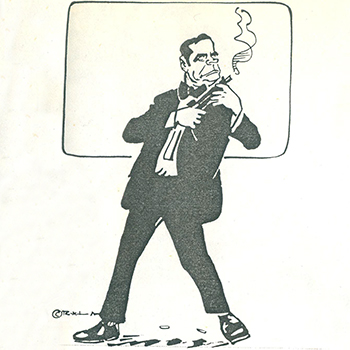


Years ago, when he was "bigger,better, Bond and beyond", in those legendary Bond sagas like Dr. No and Goldfinger, Sean Connery cried out in anger: "I’ve always hated that damn James Bond. I’d like to kill him!". The rancour was understandable. For here was an image that had grown larger than the actor: a fictitious character who had gained iconic proportions as the one-man army against evil; and a celluloid series that promised to go on indefinitely, despite the falling grandeur, increasing pyrotechnics, failing histrionis, and dwindling charisma... and yet it goes on.
Such is the saga of the super secret agent who emerged out of the imagination of Ian Fleming in 1952 and went on to become one of the most popular and legendary characters, spanning four decades, eighteen films, and fourteen Ian Fleming novels, including a number of short stories. Today, James Bond is history, which is not dead but ever alive and kicking-neither shaken nor stirred.
It is a truly remarkable achievement for an intensely personal creation, created, initially, as a money spinner and a means of escape for its author. In return, James Bond 007-license to kill, has provided escape and enjoyment for 100 million readers and one and a half billion cinegoers, and has earned a permanent place in the world’s consciousness.
James Bond has become a worldwide cult figure, crossing all race and language barriers and proving he is something much more than Secret Agent 007! What is it about this character that stirs, grips, and mesmerises in celluloid as well as in pulp? Many critics and authors have attempted explanations for it: Len Deighton; Raymond Chandler; Kingsley Amis; John Le Carre. Film and Filming, the prestigious cinema magazines, stated: "James Bond is not a screen hero, he is an institution, and as such has influenced world affairs, art, music, motion pictures, and fashion."
Critics have attributed his appeal to'sex, sadism and snoberry’; the films have been panned for their unheatable blend of conspicuous consumption, brandname snobbery, colour supplement chic, comic-strip sex and violence, and technical wizardry. Fleming himself generally felt that Bond should not be analysed too closely and said; They’re reading too much into the man—he's not all that important. This may be so, but there is unquestionably something in the Bond formula which still leaves people the world over asking for more, even though the fantasy remains the same. A new world, new threats, new enemies, yet the only man who can save the world is still James Bond: England’s dream do-gooder who carries on the good work long after the sun has set.