
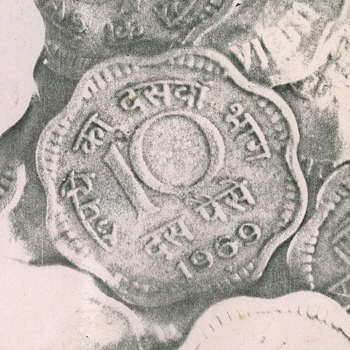


In order to understand how people can recognise the denomination of different coins in a fraction of a second, it becomes necessary to understand the whole process of how the mind works.
Among the most spectacular of our perceptual talents is the ability to recognise familiar patterns of sensory information. This talent allows us to recognise an old friend in a sea of faces or identify a coin among many others at a glance.
How do we recognise a Rs. 1-coin? Do we have a "RS.1/-" coin template that epitomises the Rs.1/- coin but will still allow us to recognise the coin when there is a change in graphics? Or do we perform a quick scan of the coin's features and compare each item to a master feature list for Rs. 1-coin coins: round, metallic, reeded edge, Lions on the obverse, approximate size, and so on? (If this represents a list of features and attributes, it could be a Rs. 1-coin, but it also might be a Rs. 2-coin.)
If the mind had to store a model of each coin and all its identifiable features, that would mean having to store millions of pieces of information. And each time a person wants to identify the coin, this is definitely not what goes on in the mind, considering the fraction of a second that it takes to identify a coin.
One possible explanation is based on template matching, i.e., pattern recognition occurs when a match is made between a perceived pattern and an abstract or idealised mental pattern. Some kind of abstraction of patterns is stored in long-term memory (LTM), and this abstraction serves as a prototype. A pattern would then be checked against the prototype, and if a resemblance were found, the pattern would be recognized. This prototypical matching hypothesis in humans seems to be compatible with neurological economy and memory research processes and allows for the recognition of patterns that are unusual but in some way related to the prototype.