
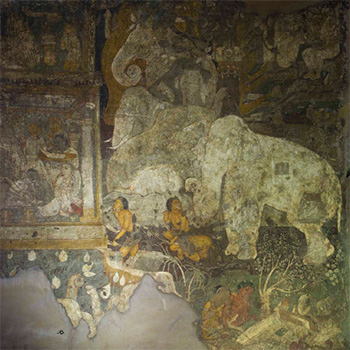









India is a diverse country which has a glorious history in art and culture from past centuries. We have the responsibility to cherish our artefacts or should be aware of them so that they are not fragile. There are numerous magnificent structures in India. The Ajanta Caves are one among them and also a world cultural heritage site. The paintings and sculptures in the caves are getting fragile, and the tourists who visit the caves are unable to understand the paintings due to several reasons, like some portions of paintings having dissipated, which is resulting in difficulty interpreting the information of the art, especially the narrative paintings because they are not in a linear pattern. Therefore, several measures are taken by ASI (Archaeological Survey of India) for conserving the historic art. Some people are also trying to digitalise the paintings before they get fragile. Therefore, even a design team from IIT-Bombay also takes a step ahead to conserve the historic Ajanta art on various platforms like digital and immersive virtual reality. The aim is not only to preserve and reconstruct the artefacts digitally but also to make the world understand the potential of art by giving the right information about the exhibits and communicating the stories of narrative paintings using animation as a medium so that it will be useful for education and researchers to know them in a better way. The other purpose is to bring Ajanta to the people who are unable to visit the site in person. In this paper, I would like to present the insight on why Ajanta is for contemporary museums, hands-on experience, advantages of virtual experiential museums, and how the technology is significant for museums.